About Logo
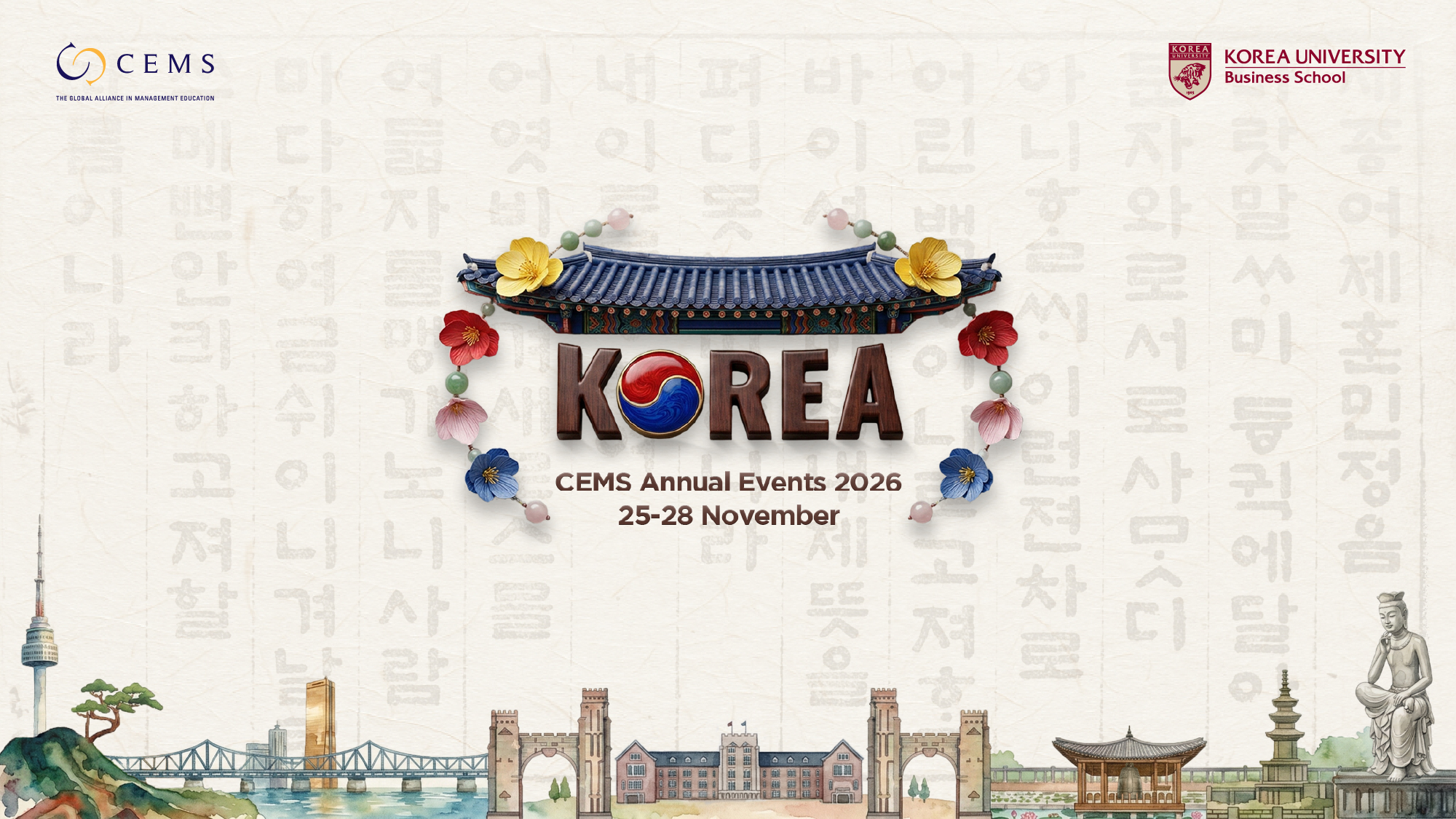
The logo brings together elements rooted in Korea’s history to trace a progression—from academic achievement to leadership and, ultimately, to social contribution—aligned with the values of CEMS. It is composed of three interconnected parts: the central motif, the lower section, and the background.
At the center is the Eohsahwa, a ceremonial flower awarded in historic Korea to those who achieved the highest distinction in the state examination. Above it, a roof form derived from traditional palace architecture represents the spaces where these individuals went on to serve in roles of leadership within society. The Taeguk, a central component of the Korean national flag, reflects balance and harmony as essential qualities of leadership. Together, these elements frame graduation as the point at which academic accomplishment evolves into leadership.
The lower section illustrates how Korea’s heritage develops into contemporary culture and innovation. On the right, the Pensive Bodhisattva, Seokgatap Pagoda, and Bosingak Belfry exemplify Korea’s historical and cultural foundations. On the left, Namsan Tower, the 63 Building, the Han River, and the Railway Bridge symbolize Korea’s modernization. At the center, Korea University represents the point where these layers intersect and are carried forward, positioning education as both the transmission of knowledge and a process of reinterpretation and extension.
The background features text from the 1446 preface explaining the purpose behind the creation of Hangul. Hangul was invented out of compassion for people who struggled with existing writing systems, to make knowledge accessible to all. Its creation reflects both scientific rigor and a deliberate commitment to inclusivity and social responsibility.